“With regard to performance, commitment, effort, dedication, there is no middle ground. You do something very well or not at all.”
– Senna
We are short Iris Energy Limited (“IREN”, “the Company”), a bitcoin miner that now promotes itself as a high performance computing (“HPC”) data center play. IREN was founded in 2018 as a bitcoin miner, but now in 2024 claims its facilities have always been primed for HPC, touting for example that, “from Day 1, we’ve built out our facilities” as “multi-decade high-performance data centers” with “no cutting corners.” This narrative is entirely contrived: IREN’s facilities were all constructed and commissioned prior to April 2023, but IREN’s convenient HPC pivot kicked into high gear in June 2023 – just three months after the launch of ChatGPT-4. Our analysis further shows that IREN’s flagship Childress buildout lacks numerous features that are critical to HPC applications. Co-CEO Daniel Roberts – who lives on the other side of the planet in Sydney, Australia – has promoted IREN shares incessantly on multiple paid interview platforms. However, behind the scenes, starting in February 2024, both Daniel and his Co-CEO and brother Will have started selling their own shares for the first time since the Company’s IPO. There’s a term for this. Since 2020, IREN has burned $716 million in cash, and funded this charade by diluting investors to seemingly no end – share count has exploded 12x in the past 4 years. We believe IREN is a painfully transparent stock promotion that will unravel as investors realize the Company’s HPC claims are nonsense and IREN remains a cash guzzling machine.
IREN talks a big game of its HPC plans, but ultimately seems entirely disinterested in actually doing what it takes to compete in the space. Look no further than IREN’s own financials: the Company has spent less than $1 million per MW to build out its existing footprint, and tells investors it will complete the Childress build for a similar sub-
$1 million per MW figure. Meanwhile, leading operators, analysts, and experts all confirm that the true cost to develop an HPC-ready data center is ~$10 to $20 million per MW. To analogize, IREN claims that it’s set to win the Monaco Grand Prix, but just arrived to the track in a Toyota Prius.
Courtesy of Google Bard
Our review of Childress’ technical specifications reveals numerous deficiencies:
- IREN implies it can build Childress to “Tier 3” data center standards or better, which hold at least one, if not two power redundancies, usually in the form of batteries, then diesel However, Childress – which is powered a single transmission line – has zero apparent backup power or uninterruptible power supplies (“UPS”). IREN’s now stuck; sources say lead times are now at least a year, while we estimate batteries and diesel generators would cost $1 billion or more if IREN were to ever build 600 MW in full.
- IREN claims to have “proven” that its air cooling will be sufficient for GPU clusters in Texas. This claim is incredibly misleading for two reasons. First, IREN has only ever tested GPUs in British Columbia, not Texas, where temperatures are 20 to 40 degrees hotter year-round. Second, our review of the specs on IREN’s AI servers suggests that they can only operate up to 95 degrees, as compared to 113 degrees for Antminer ASICs. As confirmed by the words of one industry consultant we spoke with, “if they [IREN] claim that they’re doing air cooling in Texas, they’re ” IREN’s clinging to air cooling also stands at odds with numerous HPC-ready data centers we reviewed, which overwhelmingly employ liquid or other next-gen cooling systems in high-density racks. Finally, IREN’s air cooling solution will be left in the dust as NVIDIA’s next-generation architecture requires liquid cooling.
- IREN claims that Childress is an attractive asset because of its access to low-cost power, yet this ignores the fact that IREN’s low-cost power has historically been a function of BTC mining curtailments and power sales back to the grid. In an HPC environment requiring 99.9% or greater uptimes, we believe IREN would need to form a new power purchase agreement (“PPA”) at significantly higher costs.
While best-in-class data centers position themselves in fiber and infrastructure-rich locales such as Northern Virginia, the Bay Area, or Austin,
- Childress is in a literal and figurative desert. FCC data shows Childress County holds just a single fiber line, an anomaly among other Texas sites such as those from Core Scientific (22 lines) and Elon Musk’s Giga Factory (18 lines). In our view, the very fact that IREN decided to build in Childress at all disproves the notion that IREN had ever planned on building anything more than a crypto mining operation, let alone well-equipped “long-term” HPC data centers.
IREN’s misrepresentations don’t stop there. The Company further claims its undeveloped land and power agreements are worth $5 to $12 million per MW, implying billions in latent value, even as the Company spent just
$4.7 million for its 1,400 MW West Texas interconnection deposit in November 2023. Yet IREN bases this claim by blatantly misquoting a Morgan Stanley research note that referred to the value not of land and power, but of fully built infrastructure that could be readily converted to HPC applications, hence saving time vs. ground-up development. Indeed, the very same Morgan Stanley note estimates ground-up development costs of $12 million per MW – again 12x what IREN is spending to develop what it claims are similar assets.
Nevertheless, led on by these misrepresentations, IREN shares have become wildly overvalued vs. both M&A comps and publicly traded peers:
- IREN trades at $7.6 million per MW, reflecting the errant view that the Company’s MW are tied to HPC- ready data centers. By contrast, recent M&A such as CoreWeave’s offer for Core Scientific (CORZ), RIOT’s offer for Bitfarms (BITF), and CleanSpark’s (CLSK) offer for GRIID (GRDI) were at valuations of $2.3M, $2.6M, and $2.8M per MW, respectively. If IREN were to trade at a similar multiple, shares would trade 55% lower.
- With respect to public peers, again IREN trades at $7.6 million per MW, or $4.5 million per forward MW vs. peers at an average $3.5 million per current MW, or $1.5 million per forward MW, again implying
~50% downside to IREN shares.
IREN’s “Purpose Built” Claims are Total Nonsense: IREN Was Never, And Will Never Be a Primetime HPC Data Center Operator
IREN was founded in 2018 and went public on the NASDAQ in November 2021. IREN holds four sites located in Canal Flats, BC (30 MW), Mackenzie, BC (80 MW), Prince George, BC (50 MW), and Childress, Texas (100 MW). IREN initially acquired its Childress connection agreement in January 2022, and the site was launched in April 2023 as a bitcoin mining facility holding 0.6 EH/s and 20 MW of capacity.1 Notably, these facilities were all constructed prior to IREN’s convenient mid-2023 pivot to AI.
This pivot came as IREN’s actual business of bitcoin mining was imploding, and the Company stared down the barrel of the April 2024 halving. IREN’s mining efficiency has been decimated; BTC mined per EH/s fell from
81.6 to 30.4 in the past year alone, and continues to worsen post-halving:
From 2020 to March 31, 2024, IREN burned a remarkable $716 million in cash, while never paying a dividend or returning capital to shareholders. Instead, the Company has ruthlessly diluted shareholders to fund the purchase of ever-depreciating miners.2
Against this onslaught, IREN Co-CEO Daniel Roberts now takes to paid stock promotion outlets such as McNallie Money and Proactive Investors to claim that, in fact, IREN’s facilities have always been built with HPC applications in mind:
“What we foreshadowed when we started IREN [in 2018] was the emergence of power-dense compute… From Day 1, we’ve built out the facilities, both from an infrastructure and networking and communications perspective to be fit for purpose for different functionality… Long term infrastructure, no cutting corners, we’re building multi decade data centers… We’ve built this base layer, this bedrock of high-performance data centers that can do any high-performance compute.”
- Co-CEO Daniel Roberts, March 2024 promotional interview
“Specifically designed and purpose-built infrastructure for high-performance and power-dense computing applications.”
- Numerous IREN press releases, 2024
“So if you look at the facilities, we’ve designed our network core. So this is networking, storage, communications around industry best practice and Tier 4 design principles.”3
- Co-CEO Daniel Roberts, November 21, 2023 conference call
These claims are total nonsense – IREN has always, and will continue to be – a non-player in the HPC space because its facilities were built for BTC mining and are ill-equipped for HPC workloads without billions in additional costs. To illustrate, IREN’s 2022 Form 20-F contained zero mentions of “HPC”, but IREN’s 2023 annual report mentioned “HPC” a remarkable 97 times. This desperate narrative shift reminds us of COVID-era biotech frauds that took advantage of investors’ hope for solutions by touting nonsensical or nonexistent COVID- 19 vaccines or therapeutics. We wrote about three such promotions: CytoDyn (CYDY), VBI Vaccines (VBIV), and Veru (VERU), each of which subsequently declined over 90% as their grandiose claims were found hollow. We think IREN will follow in their footsteps.
IREN’s Claims of “Purpose-Built” HPC/AI-Ready Data Centers are Nonsense
We’re short IREN because we believe the Company has dramatically misrepresented the strength and potential of its assets for HPC/AI applications. As of the Company’s most recent June 2024 update, IREN’s “data center” business consists of 260 MW of operating power, which the Company expects to grow to 510 MW by year-end, driven by expansions at the Company’s Childress facility, as shown below:
IREN claims its “long-term” infrastructure is well-equipped for HPC and AI applications, but what the Company is actually building at Childress lacks numerous key features built by competitors, as shown below. Note that while these competitors may present their specifications in slightly different manners or have different solutions to redundancies, the end result remains resoundingly clear: IREN is not a serious player in the space.
IREN is Spending Less than $1M per MW, While True HPC-Ready Data Centers Cost ~10x More
IREN’s claims that both its existing footprint and its Childress expansion are “HPC-ready” fly in the face of widespread industry estimates regarding how much it costs to build HPC-ready data centers. As of IREN’s most recent quarterly report, the Company held just $168.8 million in buildings, at cost, while reporting 220 MW of power at these facilities, implying that IREN spent a mere $771,818 per MW to develop its existing footprint.7 IREN then claims it is building Childress into an HPC-ready data center for a similar cost, with Phase 2 consisting of a 150 MW buildout costing a mere $110 million.8
The idea that IREN could possibly build HPC-ready facilities for $750,000 per MW is laughable. Numerous operators building actual HPC-ready data centers report costs per MW that are an order of magnitude greater than IREN’s claims. For example:
- In June 2024, Core Scientific (CORZ) signed a deal with CoreWeave that contemplates upgrades to its existing facilities which CORZ estimates will cost an incremental $5 million to $8 million per MW, again excluding the cost of GPUs. Core Scientific also specified that these incremental upgrade costs include “generators, chillers, batteries, and the cost to install that equipment.”9 As we detail further, IREN’s facilities lack many of these key redundancies.
- In its May 2024 investor presentation, Terawulf (WULF) detailed the potential economics of setting up its own cloud service provider business. WULF similarly quoted a total build cost per MW of $27 to $30 million per MW (including GPUs). Assuming that GPUs are half of total costs implies data center costs of
$13.5 to $15.0 million in capex per MW.10
- In March 2024, it was reported that Microsoft and OpenAI are planning to build 5 GW (5,000 MW) facility to be launched in 2028, that they estimate will cost $100 billion, or $20 million per MW.
- In late 2023, Applied Digital (APLD) broke ground on its 100 MW data center in Ellendale, North Dakota, which will include peak rack load of 120 kW per rack, liquid cooling, and 1.3 peak PUE, and according to CEO Wesley Cummins, will cost “$6 million to $7 million per megawatt.”11
- In September 2023, VIRTUS Data Centres announced it would be building out a 300 MW facility in Brandenburg, Germany, at an estimated cost of $3.2 billion USD, or $10.67 million per MW.
More generally, industry experts and sell-side analysts corroborate these figures. In a June 2024 report, Morgan Stanley estimated the total cost to build a new HPC-ready data center at $12 million per MW, excluding the cost of GPUs.12 A June 2024 report from JP Morgan states, “it normally takes 3 to 5 years to build an HPC-grade data center from scratch and can cost as much as $20M per MW.” Finally, a May 2024 Needham report compares the development costs of HPC data centers to those of bitcoin mining operations, stating, “HPC data centers are running at $8-10m per MW in capex (not including GPUs). A bitcoin mining site typically runs at $300-800k per
MW in capex (not including ASICs).” Tellingly, IREN’s costs fall squarely in the latter camp. See finally that JLL’s Senior Director of Data Centers cites development costs of $7 to $10 million per MW.
Childress Has Just a Single Transmission Line and Zero Backup Power
True HPC-ready data centers have at least one, usually two, and as many as four backup power sources. Childress has zero. Unlike BTC mining, which can – and often by design – curtails power for minutes, hours, or even days, HPC demands near-100% uptime. As it was put to us by one industry advisor, “In order to have 99% uptime, you need certain levels of redundancy.” Yet IREN appears to bury its proverbial head in the sand, refusing to spend the necessary money to develop backup power / uninterruptible power supplies (“UPS”). This is further problematic given that Childress appears to have access to just a single 345 kV transmission line, as shown below.
Source: Childress County Tax Abatement documents
In layman’s terms, potential customers such as OpenAI like to know that, say there were a storm, that their facilities wouldn’t simply go down. Unfortunately, IREN doesn’t seem to care. As confirmed by a former IREN executive we spoke with:
“They don’t have redundancies… [Power] It’s from one source. For some reason if something went down on the main grid, that’s it. They don’t have a generator sitting beside there.”
NVIDIA’s own DGX H100 specs call for power redundancies that “meet or exceed Uptime Institute Tier 3 design standards…” The Uptime Institute refers to Tier 3 designs as those where:
“Each and every capacity component and distribution path in a site can be removed on a planned basis for maintenance or replacement without impacting operations. The site is still exposed to an equipment failure or operator error.”
It seems clear to us that IREN’s facilities, without backup power, would never meet this criteria. This need for backup power is widely acknowledged among public and private operators alike. Consider that Core Scientific’s deal with CoreWeave requires backup power, among numerous other redundancies. As per CEO Adam Sullivan on CORZ’s June 2024 conference call:
“Our approach here is to target these areas for high levels of resiliency by giving them additional backup capabilities, power backup capabilities, cooling capabilities, et cetera. So that will allow concurrent maintainability of that portion of the infrastructure…”
We also spoke with an executive at one of the top privately held HPC data center operators, who explained to us that their own data centers are being built with not just one, but two layers of backup power, through both batteries and diesel-fueled generators. Backup batteries are commonly engineered to produce 4 hours of backup power, while diesel generators can run for days, depending on their specifications:
“The first level for our design are batteries – uninterrupted power supply. You’ve got hours [worth of power] on that. We then have semi-truck sized generators on site with enough fuel to run for days, from a power perspective… We’re talking tens of thousands of gallons of fuel on site.”
This dynamic is also widely acknowledged among providers of such backup power and battery storage. For example, on Generac’s (GNRC) May 2024 conference call, CEO Aaron Jagfeld called out “the recent acceleration in data center construction activity” as fueling “industry-wide demand for backup power.” Similarly, Ballard Power Systems (BLDP) CEO Randall MacEwen noted in the Company’s March 2024 call that “the data center market offers considerable opportunities to deploy our products as backup power.” In other words, everyone else is buying backup power, but IREN isn’t.
We believe IREN cannot possibly compete as on the level of true HPC data centers without these backup systems, yet procuring and building these backup systems would be (a) incredibly costly, (b) time-consuming, and (c) ruinous to the Company’s ESG narrative.
With respect to backup batteries, given cost estimates of $1,000 to $1,500 per kW13 and IREN’s disclosed 1.1x power usage effectiveness (“PUE”)14 target at Childress, we estimate a 600 MW backup system would cost $660 to $990 million.
With respect to generators, we spoke with a well-established HPC data center operator who claimed that lead times are currently “greater than 52 weeks” as of our June 2024 conversation. These long lead times are corroborated by public operators such as Equinix (EQIX), which stated, for example, in an August 2023 conference call that “to get us a 3 MW generator right now is 120 weeks. So if you’re not in line already, you’re having a lot of challenges.” Our conversations with industry experts as well as our review of small-scale backup generators currently for sale on third-party websites suggests that IREN would need to spend another $300 million or more to equip Childress’ 600 MW with full backup generator power.15
Moreover, the use of generators would ruin IREN’s “clean energy” story, as diesel is notoriously dirty, while clean options such as microgrids would be even costlier; a 2018 NREL study estimated microgrid development costs at
$2 to $5 million per MW, implying $1.3 to $3.3 billion in costs to cover Childress’s 600 MW at 1.1x PUE.
Childress Lacks Liquid Cooling; IREN’s Air Cooling Plans are Nonsensical
In the same manner, IREN claims that it can keep Childress operating with “high uptimes” using its existing cooling systems, that to this point have only ever been used to cool BTC miners.16 We believe, however, that existing air cooling is not only insufficient for HPC applications, especially in the extreme temperatures of West Texas, but that over time, they will be rendered obsolete by next-generation NVIDIA architectures that require liquid cooling. IREN appears to be dancing around the issue, because to admit that its existing systems are insufficient would be to admit that the Company must again spend gobs of money to upgrade to new systems.
IREN Co-CEO Daniel Roberts has continually held that IREN’s existing air cooling is the proper solution for HPC applications and high rack densities, even while competitors overwhelmingly utilize liquid cooling:
“Hydro cooling… that’s not something that’s as much of interest to us, and similarly immersion today, we’re doing a bit of R&D, is not that of interest. Purely and simply because air cooling is really efficient if you get it right.” – February 2023 conference call
Roberts even went so far as to say that “the laws of physics” make air cooling more effective than immersion cooling “in Texas.” It’s unclear to us what Roberts means by this, given that liquids like water and dielectric fluids have a higher specific heat capacity (i.e., how much heat is needed to make the material one degree warmer) and thermal conductivity (i.e., the material’s ability to transfer heat) as compared to air. It’s also unclear to us how, specifically, Roberts thinks the laws of physics change once one enters the State of Texas.
“You cannot manage heat as effectively with immersion cooling in Texas. It is just the laws of physics. It becomes exponentially hard when you’re trying to evacuate heat kind of a fluid in 100-degree temperature.” – September 2023 conference call
Roberts then two months later admitted that some customers and stakeholders were more biased towards liquid cooling; a tacit admission, in our view, that the Company’s existing systems are insufficient.
“In terms of GPUs, there’s obviously more unknowns around that and how that will play out. Our bias is still well and truly towards air cool, and we believe that that’s probably the way to go. But equally, we’re now dealing with customers and third parties and other stakeholders… and they may be more biased to liquid cooling.” – November 2023 conference call
We don’t believe air cooling alone will work well in IREN’s Childress facility, and IREN misrepresents their ability to do so. For example, in a June 2024 McNallie Money interview, Co-CEO Daniel Roberts claimed:
“We’ve proven we can operate these things up to 110 degrees Fahrenheit. It hasn’t been hotter. Even things like transformers, we over-spec the capacity.”
Yet Roberts’ claim that IREN has “proven” HPC operations in Texas is a total a misrepresentation for two reasons – British Columbia is not Texas, and AI/HPC servers are not ASICs.
- First, IREN has never demonstrated that it can operate GPUs in Childress, only in Prince George, BC, where temperatures are consistently 20 to 40 degrees lower throughout the year. Put simply in the words of one industry consultant we spoke with, “If they [IREN] say that [air cooling is sufficient] about HPC in Texas, they’re crazy.”
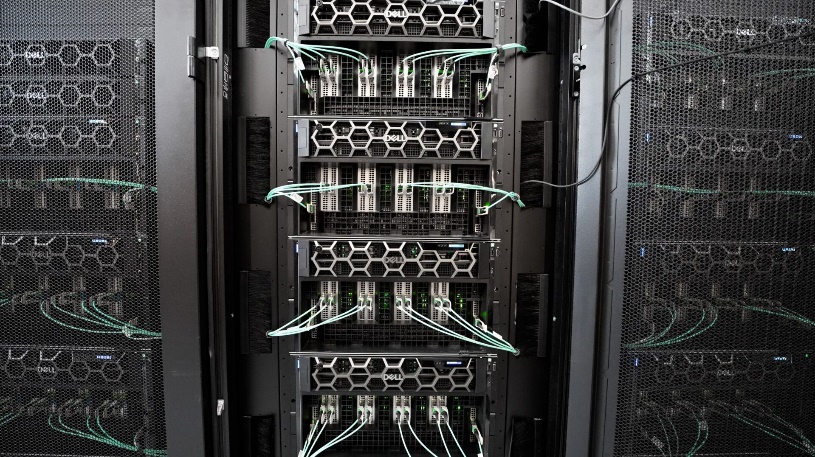
- Similarly, AI/HPC servers must maintain lower temperatures than ASICs to maintain performance. See per an IREN April 2024 press release that the Company appears to be using Dell XE9680 servers at its Prince George, BC location. Dell specifies the XE9680 has a maximum dry bulb temperature of 95 degrees, but it is not recommended to reach that temperature without risking damage. On the other hand, an Antminer S21 ASIC lists a max ambient temperature (i.e., the air outside of the fan) of 113 degrees, while the ASIC will start underclocking above 104 degrees.
An executive at Microsoft involved with the Company’s data center strategy was asked explicitly whether air cooling alone would be sufficient in Texas, to which they replied:17
“I would highly 100% disagree with that [that air cooling is sufficient]. That is not the case. If anything, you need more localized cooling, you don’t need to just air cool it. I mean, we do have some data centers like out in Massachusetts, where we didn’t have any liquid cooling there until we brought in the GPUs. But then those GPUs run exceptionally hot. And if you have them burn out, then you just threw away $41,000. You want to make sure that you’ve got localized direct to chip, that you want to use urethane foams, that you’ve got gels on there. We also do rear-door heat exchangers in addition to direct- to-chip. We’ve been working on Phase II and Phase III liquid cooling, too. So if anything, actually, no, we’re making a lot more investments in liquid cooling. But those Texas data centers, too, you can’t just operate GPUs in there and not have liquid cooling. Those things get 110, 120 degrees of just ambient temperatures. And that’s especially when you get humidity out there, that will degrade the quality of those GPUs even more. So no, you have to use liquid cooling.”
Comments from industry stakeholders and other operators constantly call out the attractiveness of liquid cooling.
These views are corroborated by our informal survey of actual HPC data center providers, who again offer or even require liquid cooling above certain rack densities.
IREN’s air cooling by contrast is not only ill equipped for the present, but we believe would be rendered obsolete in the near future, as NVIDIA’s next generation Blackwell GPUs require liquid cooling (alluded to by Vertiv above). As it was put by Dell’Oro Group’s Lucas Beran to Fierce Network:
“If you’re going to be deploying accelerated computing you should be deploying liquid cooling and if you’re not you need to be planning to deploy liquid cooling in the future if you want to continue to deploy the latest and greatest accelerated infrastructure.”
Even on Twitter, IREN Co-CEO Roberts misrepresents the Company’s air cooling to investors. For example, in June, Roberts piggybacked an Elon Musk tweet and claimed that IREN’s designs are “similar to” those being built by Musk, evidently for the sole reason that both facilities contain fans. Notwithstanding the fact that the Gigafactory’s fans are an order of magnitude larger than IREN’s (see IREN’s Prince George vs. the Gigafactory), Musk himself preaches the superiority of liquid cooling and confirmed that they will be using “massive” liquid cooling systems at their facilities. So in fact, the designs are not “similar” at all.
IREN Doesn’t Even Have a Power Contract Signed in Texas
Investors also mistakenly point to IREN’s current low power costs as if these power costs will translate to an HPC environment. They won’t. IREN’s Childress facility operates in a deregulated power market (ERCOT), where the Company has maintained low power costs by often curtailing power and participating in demand response programs wherein the Company sells power back to the grid when advantageous to do so. However, in any HPC applications, where Tier 3 and 4 data center standards call for 99.98% uptime or more, we believe IREN would need to sign new PPAs to ensure reliability. See for example from Core Scientific, which admitted this to investors in its June 2024 call regarding its deal with CoreWeave:
“And on a go-forward basis, if we evaluate potentially bringing HPC to any of our Texas locations, we would be signing new PPAs that would be for what the data center really desires and needs, which is a much higher uptime than what we currently operate at for Bitcoin mining.”20
IREN has seemingly ignored this issue because, again, addressing it would be costly and would hamper the Company’s “HPC-ready” narrative.
IREN’s Childress is in Both a Literal and Figurative Desert
While best-in-class data centers are placed in high-value locales with rich infrastructure such as Northern Virginia and the Bay Area, IREN has plopped its flagship facility in both the literal and figurative desert of Texas: Childress is located 206 miles from Oklahoma City and 221 miles from Dallas/Fort Worth. Proximity to major metro areas is important for a number of reasons, including access to fiber providers, reduced latency (especially important for real-time data processing applications), proximity to undersea internet cables, and the ability to attract talented employees.
On the other hand, according to the FCC’s Texas Broadband Development Map, there is only a single (1) provider of fiber services in Childress County, Texas. By contrast, Core Scientific’s (CORZ) facility in Denton County has 22 different fiber providers available. Travis County, home of Tesla’s Giga Factory, has 18 providers available. Childress’s closest undersea cable – which runs from Freeport, TX to Pascagoula, MS – is 543 miles away.21 In our view, the very fact that IREN is building in Childress disproves the notion that the Company ever intended its facilities to be used for anything besides crypto mining.
IREN’s Poolside Deal Exposes the Company’s Frailty, Not Its Strength
IREN investors tout the Company’s February 2024 agreement with Poolside AI as proof of IREN’s ability to operate AI/HPC clusters successfully, but far from it, we believe the deal exposes IREN’s frailty. First, the Poolside deal is a 4-month renewable contract wherein Poolside is effectively renting IREN’s GPUs at the Company’s Prince George site. First, the length of the contract suggests to us that Poolside was wary of staying with IREN over the long term. Moreover, Poolside is using just 500 NVIDIA H100 GPUs, while IREN currently has 816 total H100 GPUs and far more power supposedly available at Prince George. Yet despite overflowing demand for power and GPUs, IREN has not named any other customers that have agreed to rent the rest of its GPU capacity. Compare this to Microsoft, where, per an interview with a top executive, all available compute is filled up in a mere “two and a half hours” after launch:
“It takes us, on average, about 18 days, and we will build out an AI cluster that’s got about 8,192 GPUs in it. We’ll fill that up in about two and a half hours of it just being brought online. Right now, the demand is just so high…”
IREN’s lack of customer announcements, by contrast, suggests to us either that Prince George’s true “HPC-ready” capacity is quite meager, or that other potential customers have balked at IREN’s facilities.
IREN Blatantly Lies About the Value of its Undeveloped Land and Power
IREN not only misrepresents its existing operations and its expansion at Childress, but the value of its undeveloped land and power. For example, the Company implied on its May 15, 2024 conference call that it’s worth tens of billions of dollars, based on a Morgan Stanley report:
“In fact, the Morgan Stanley report went into some detailed quantitative analysis around what the value of having power and land was, and they came up with a number of $5 to $12 per watt. We’ve got 3 billion watts. So that implies a tremendous amount of value in the portfolio.”
Yet if investors actually read the referenced Morgan Stanley research note, they would find that the analyst referred to value not solely in “power and land”, but in existing crypto sites that could be converted to HPC:
The analysts’ argument is based not primarily on the value of the power, but on the time savings that could result from converting existing BTC mining operations into HPC operations, rather than building HPC-ready data centers from the ground up (i.e., using undeveloped land and power). Indeed, if IREN ever wanted to actually develop actual HPC-ready data centers, the very same Morgan Stanley report estimates that it would cost $12 million per MW – again 12x to 15x what IREN is actually spending.
In reality, IREN paid just a $4.7 million deposit for the 1,400 MW initial connection in late 2023; Roberts’ implicit claims that the asset is worth billions less than a year later is total nonsense.
Even if we Took Their HPC Plans Seriously, IREN Shares Are Wildly Overvalued
We view IREN shares as wildly overvalued when considered on a standalone basis, compared to precedent M&A deals, and the Company’s publicly traded peers. IREN’s valuation can be thought of in three buckets: the value of its existing facilities, the value of its undeveloped power, and the value of its crypto mining operations.
– As they sit, we believe IREN’s existing facilities, holding 260 MW of power, are worth $1.0 to $2.0 million per MW. We feel this is generous, given both that IREN has spent less than $1 million per MW to develop these facilities, while numerous recent bitcoin mining deals have fetched multiples well below
$500K per MW, as shown in the table below.
- We ascribe $10 to $100 million in value to the Company’s undeveloped land and power, which we again feel is generous, given that IREN paid just $4.7 million for its 1,400 MW interconnection in November.
- We ascribe $0 to $100 million in value to the Company’s crypto mining operations, which again we feel is generous given that the business has historically burned cash, while the April 2024 halving has further decimated economics and miners continue to grow their hash rates aggressively over the coming years.
In summary, IREN is worth anywhere from 52% to 79% less than current prices on this sum of the parts basis.
Our views are corroborated by recent public deals in the space. While investors view recent M&A as bullish for IREN, we instead see these deals as exposing IREN’s ridiculous overvaluation. As shown below, each deal implied a valuation of $2.5 million per MW, on average. At the same multiple, IREN would trade to $5.75 per share, or 59% less than today’s price. Investors wishing for a buyout offer like those received by Core or Griid should be careful what they wish for.
We note that speculators in Griid (GRDI) saw the very same disappointment, in part due to drummed up rumors spread by IREN’s own board member, Mike Alfred. In the ensuing days, Griid (GRDI) shares would rise from their June 18, 2024 closing price of $0.56 per share to reach a high of $3.29 per share (+488%), only to then collapse 67% from the highs, as CleanSpark revealed that it would only be paying $155 million, or an implied
$2.3 million per MW, to acquire Griid.
Finally, we find IREN wildly overvalued when compared to other publicly traded BTC on an EV to MW basis:
IREN’s Co-CEO Roberts Claims to be Conservative, But Misses Deadlines Anyway
IREN is run by Co-Founders, Co-CEOs, and brothers, Daniel Roberts and Will Roberts, who appear to remain in Sydney, Australia, thousands of miles from the Company’s facilities in Texas and British Columbia. Nevertheless, that hasn’t stopped Daniel from promoting the Company across various media outlets – both paid and unpaid. Daniel frequently touts the Company’s supposed conservativism, for example claiming in a June 2024 interview with the paid promotional outlet McNallie Money, that “We don’t publish something unless we’re super confident that we’ll at least hit it.” Yet even in IREN’s brief publicly traded history, the Company failed to meet its own deadlines. For example, in February 2022, IREN claimed that it would have 10 EH/s of mining capacity by early 2023, with Roberts referring to the projections as if they were a certainty:
“As you can see, we’ve announced to the market our current contractual profile. To be clear: This is not a forecast. This does not account for any additional [ hardware ] orders. This is only what we have signed binding contracts for and/or have received and are operating today. So we’ve announced that, by early 2023, we’ll have 10 exahash of that capacity installed, delivering a mining profit of around $550 million,
$600 million on an annualized basis.”
In reality, by April 2023, IREN had built out just 5.5 EH/s, well below the 10 EH/s promised, and while Roberts promoted non-GAAP “mining profits” of $550 to $600 million, IREN generated LTM revenues of a mere $146 million and operating losses of $11 million. In our view, this track record doesn’t speak well to IREN’s ability to follow through on its buildout claims today, bare bones as they are.
Meanwhile, in December 2023, Daniel and Will filed Form 144’s to sell 1 million shares each. In February 2024, each of the brothers sold 1 million IREN shares each, lowering their stakes from 10.7% to 6.0%.
IREN’s auditor is Raymond Chabot Grant Thornton LLP – the Canadian branch of Grant Thornton – appointed in May 2023 after IREN’s prior auditor, Armanino LLP, left the crypto industry after facing scrutiny for auditing the now collapsed fraud, FTX. IREN’s 2023 Form 20-F contained a going concern warning and multiple critical audit matters related to bitcoin mining revenue and asset impairments.
DISCLAIMER
By downloading from or viewing material on this website you agree to the following Terms of Service. Use of Culper Research’s (“Culper”) research is at your own risk. In no event should Culper or any affiliated party be liable for any direct or indirect trading losses caused by any information on this site. You further agree to do your own research and due diligence, consult your own financial, legal, and tax advisors before making any investment decision with respect to transacting in any securities covered herein. You should assume that Culper (possibly along with or through our members, partners, affiliates, employees, and/or consultants) along with our clients and/or investors has a position in any securities covered herein. Following publication of any research, we intend to continue transacting in the securities covered herein, and we may be long, short, or neutral at any time hereafter regardless of our initial recommendation, conclusions, or opinions. Research is not investment advice nor a recommendation or solicitation to buy securities. To the best of our ability and belief, all information contained herein is accurate and reliable, and has been obtained from public sources we believe to be accurate and reliable, and who are not insiders or connected persons of the securities covered herein or who may otherwise owe any fiduciary duty or duty of confidentiality to the issuer. However, such information is presented “as is,” without warranty of any kind – whether express or implied. Culper makes no representation, express or implied, as to the accuracy, timeliness, or completeness of any such information or with regard to the results to be obtained from its use. Research may contain forward-looking statements, estimates, projections, and opinions with respect to among other things, certain accounting, legal, and regulatory issues the issuer faces and the potential impact of those issues on its future business, financial condition and results of operations, as well as more generally, the issuer’s anticipated operating performance, access to capital markets, market conditions, assets and liabilities. Such statements, estimates, projections and opinions may prove to be substantially inaccurate and are inherently subject to significant risks and uncertainties beyond Culper’s control. All expressions of opinion are subject to change without notice, and Culper does not undertake to update or supplement this report or any of the information contained herein. You agree that the information on this website is copyrighted, and you therefore agree not to distribute this information (whether the downloaded file, copies / images / reproductions, or the link to these files) in any manner other than by providing the following link — https://culperresearch.com The failure of Culper to exercise or enforce any right or provision of these Terms of Service shall not constitute a waiver of this right or provision. If any provision of these Terms of Service is found by a court of competent jurisdiction to be invalid, the parties nevertheless agree that the court should endeavor to give effect to the parties’ intentions as reflected in the provision and rule that the other provisions of these Terms of Service remain in full force and effect, in particular as to this governing law and jurisdiction provision. You agree that regardless of any statute or law to the contrary, any claim or cause of action arising out of or related to use of this website or the material herein must be filed within one (1) year after such claim or cause of action arose or be forever barred.
REFERENCES
1 See 2023 Form 20-F, page 68.
2 IREN’s total buildings, at cost, as of March 31, 2024 were $169.8 million; net mining hardware was valued at $86.4 million as of March 31, 2024, while public filings disclose that from June 30, 2022 to March 31, 2024, IREN spent at least $333.5 million on miner purchases.
3 Tier 4 data centers are designed to be completely fault-tolerant, meaning every single component has built-in redundancies. As we show in the report, IREN’s existing facilities and contemplated Childress buildout fail to meet these requirements, Roberts’ claim that IREN is building “around” these “principles” is highly misleading, in our view.
4 TeraWulf is currently building a 2MW pilot HPC/AI facility, and designing a 20 MW facility that the company characterizes as “typical of a Tier 3 data center” including “liquid cooling and redundancy requirements.”
5 Verne’s specifications cite “unparalleled rack density” though no specific figures are offered.
6 On IREN’s February 2024 conference call, Co-CEO Daniel Roberts stated “We’ve got 200 megawatts of operating data centers, over 2 gigawatts of power and associated land secured. We've got all the appropriate networking, physically dual redundant fiber.” This quote remains ambiguous as to both (a) whether Roberts was referring to dual-redundant fiber at Childress or within the Company’s undeveloped assets, and (b) whether Roberts refers to “dual redundant fiber” as meaning two connections by the same provider, or by two different providers. FCC data (as shown on page 11) shows Childress County holds just a single fiber provider. We believe “dual redundant” fiber with the same provider would still not meet HPC-ready standards.
7 220 MW as of March 31, 2024. IREN also reported $76.9 million in development assets as of March 31, 2024 which “include cost related to the development of data center infrastructure at Childress, Texas along with other early-stage development costs.” We exclude these as they represent costs not associated with power that has been fully constructed as of March 31, 2024.
8 See IREN’s May 2024 investor presentation, corroborated by comments made on the Company’s Q3 2024 conference call.
9 See June 12, 2024 conference call.
10 WULF’s estimated revenues of $11 to $18 million per MW are in line with IREN’s claims of its own BC-based cluster, which is generating ~$9.3 to $15 million per MW, on “less than 1.5 MW” of power, per IREN’s February 2024 conference call. WULF also notes that colocation and build to suit models would cost $2 to $8 million per MW, again multiples higher than IREN claims.
11 See comments from APLD CEO Wesley Cummins, January 2024 conference call.
12 As we detail on pages 12 and 13, IREN has misrepresented key elements of this report to promote its own bull case.
13 The NREL (a division of the US Department of Energy) estimates utility-scale battery capital costs of nearly $2,000 per kW, falling under $1,000 per kW by the 2040s. Similarly, consultancy Thunder Said Energy estimates battery capex costs nearing $1,500 per kW. We estimate a conservative/Company-favorable capex cost of $1,000 per kW and a high-end capex of $1,500 per kW.
14 PUE is the ratio of total facility energy consumption to the energy consumed solely by the relevant IT load (i.e., the HPC services). Lower PUEs represent more efficient data centers. We also suspect that IREN’s PUE claims of Childress are likely artificially low, given that PUEs are largely informed by the cost of cooling, while IREN’s cheap air cooling solution will be found incapable of servicing HPC servers at Childress, as described on the following pages.
15 See generators for sale, for example: here, here, here, here, and here, which are listed at a weighted-average price of $464,132 per MW, implying a cost of $306 million, assuming 600 MW and a 1.1x PUE at Childress.
16 CEO Daniel Roberts claimed in a March 2024 interview that “Our uptime and efficiency is fantastic” and then claimed in a June 2024 interview that “If it’s not 100% uptime, we ask ourselves why...”
17 Third-party call conducted with a current Microsoft executive through a leading expert network service.
18 Third-party call conducted with a current Digital Realty executive through a leading expert network service.
19 Third-party call conducted with a current Microsoft executive through a leading expert network service.
20 CEO Adam Sullivan, June 12, 2024 conference call.
21 All distances via driving distance per Google Maps.